Crocus sativus
Family- Iridiaceae
Hindi- Zaffran, Kesar
Saffron is a herbaceous, perennial, monocot with underground globular corm or bulb. It is native to Southern Europe and is cultivated in mediterranean countries, particularly in Spain, France, Austria, Greece, England, Turkey, Persia, India and the Orient. In India flowering period of the plant starts during middle or late October and lasts only until the first or second week of November. a warm spring and long autumn are conducive early flowering.

A Saffron field in Kashmir
Saffron is cultivated for its large, scented, blue or lavender flowers. The flowers have triffid, orange- coloured stigmas which along with the style-tops yield the saffron of commerce. Preparing one kg of dried Saffron requires the picking of about 2,00,000 flowers. The flowers must be hand picked each morning before the Sun gets too hot.
Cultivation and Processing

The worker employed for picking, holds a flower in the hand and with the thumbnail of the same hand, removes the pistils below the perianth, at the same time tearing off the stigmas with the fingers of the right hand and depositing these in the containers held for this purpose.The value of the saffron depends on the method by which the stigmas are dried.
In India, the stigmas picked from the flowers are dried and arranged. They constitute the first grade (Shahi Saffron).
The flowers are dried in the Sun for 3-5 days, then lightly beaten with sticks and passed through coarse sieves. The material which passes through is thrown into water, those parts of the flowers which sink to the bottom are collected and further dried, constituting the second grade (Mogra Saffron).
The discarded parts of the flowers are again subjected to the beating process and the process of throwing the entire pounded mass in water is repeated. the product which sinks is collected, and is very much inferior in value, constituting the third grade (Lachha Saffron).
In Spain, the process is called 'toasting'. The stigmas are placed in sieves, in layers 2-3 cm thick over an almost spent fire. The sieves are placed 15 cm above the fire and by stacking them and changing there order and position, the product id carefully dried. In addition the process may utilise special stoves for this purpose. Saffron has to be kept protected from dampness and light because light bleaches it into dull yellow.
Saffron is a low-growing monocot

Composition
The principal colouring agent is the glycoside crocin, the bitter substance is the glucoside picrocrocin.
Adulterants
Exhausted Saffron, flowers and floral parts of some Compositae like Calendula spp. and Carthamus tinctorius, corn silk and various materials coloured with coal tar dyes, are adulterants.
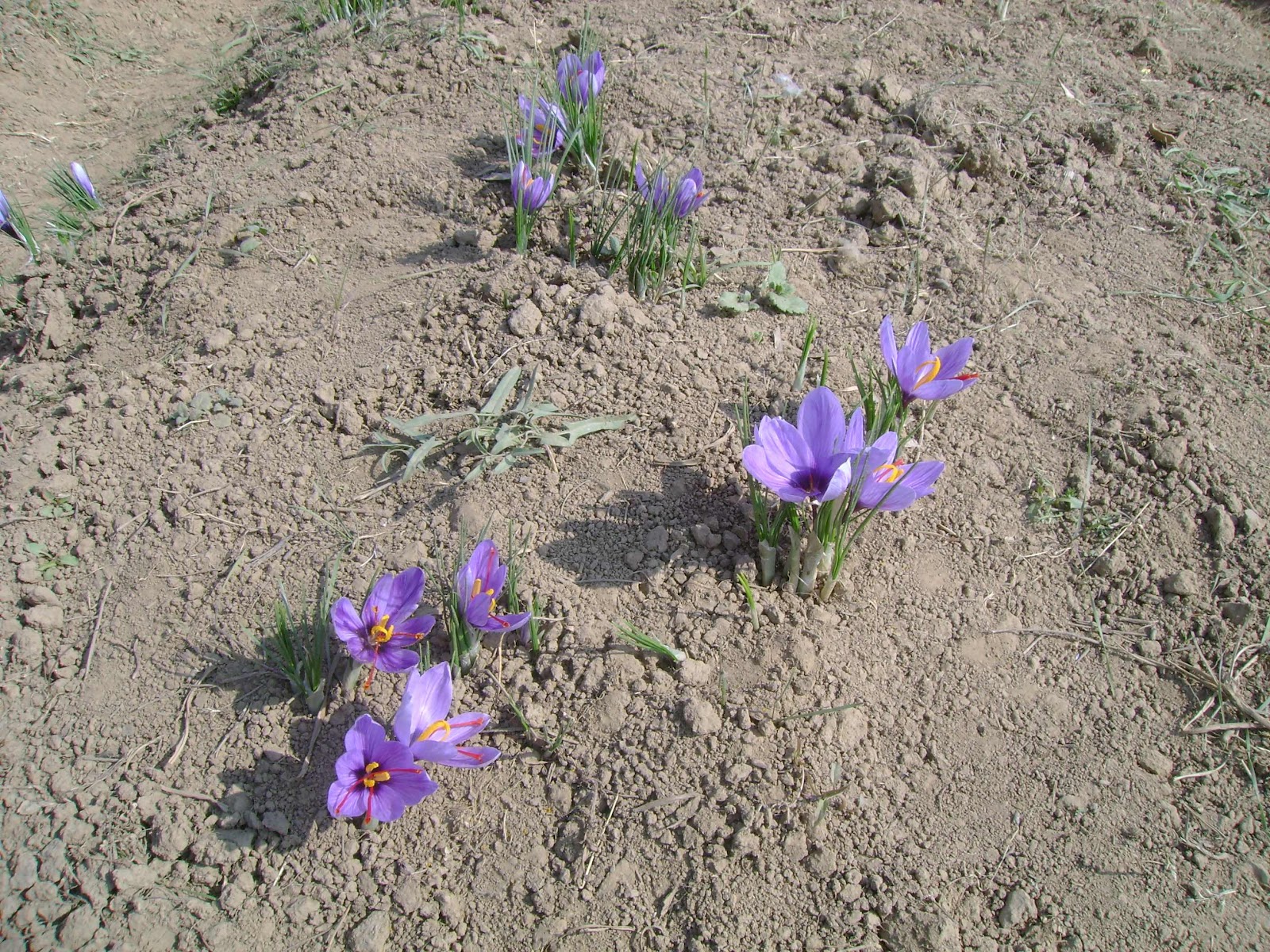
Cultivated for large scented blue or purple flowers
Uses
Saffron is famous for its extraordinary medicinal, flavouring and colouring properties.
- In medicine saffron is used in fevers, melancholia and enlargement of the liver and spleen.
- In Ayurvedic and Unani systems of medicine, saffron is known as a stimulant, warm and dry in action, helping urinary, digestive and uterine troubles.
- When pounded with ghee, it is reported to be effective in diabetes.
Comments
Post a Comment