Foxtail Millet
Family- Poaceae
Scientific Name- Setaria italica (Linn.) Beauv.
Common Name- Hindi- Kala Kangni
 |
| https://www.istockphoto.com/photo/millet-millet-in-a-wooden-container-gm1493018056-516845340?searchscope=image%2Cfilm |
Origin
- Foxtail millet was under cultivation in China as early as 2700 BC. Where will of 1935 considered China as the place of origin while proposing 12 primary centres of origin for the cultivated plant.
- Seeds of foxtail millet were found in European archaeological sites.
- It has a cosmopolitan distribution in India, China, Japan, South Africa, South and East Europe and in North America.
- It's progenitor is thought to be a common old world weed S viridis (2N = 20).
Botany of the plant
- Erect, often robust, tufted annual grass, 0.6 to 1.5 m high, branching from the crown.
- Fasciculated and prominently jointed culms.
- Leaves 15-45 cm long and 0.75-3.3 cm broad, flat, linear or lanceolate, tapering to a sebaceous point, glabrous,
- Panicles, erect or nodding
- 2-4 spikelets in each involucre, bristles, 2-9 hairy, nearly smooth, twice as long as the spikelet
- Spikelets 2-3.5 mm long, broadly oblong to broadly elliptic, persistent
- Lower floret barren, upper floret hermaphrodite
- Caryopsis, 1.8-2.5 mm long, ellipsoidal or globose ellipsoidal, with persistent glumes, smooth, shining, with varying colours.
Species of Setaria
- S. verticillatum, Rough bristle grass- A coarse, flaccid, annual grass, upto 3m high, with loosely tufted culms. The grain is eaten and leaves are used as cattle feed.
- S. plicata An erect, tall, perennial grass, 0.3-2.4 m high, arising from a woody rootstock.
- S. viridis, Green bristle grass- A tufted annual grass, 15-40 cm high. Drought-resistant and gives high yields of grain and hay.
- S. pallide-fusca, It is a tufted, annual grass, 30 to 60 m high. Reported to be an excellent fodder for all stock.
- S. homonyma, Fastgrowing grass, used as fodder.
Cultivation in India
It is grown as a main crop in many states, especially in Andhra Pradesh, Gujarat, Tamil Nadu, Maharashtra and Karnataka. It is occasionally grown as a water crop in Andhra Pradesh, Tamil Nadu, Maharashtra and Gujarat.
Ecology
It is essentially a dry land crop and can be grown throughout the year. It is suited to low rainfall ranging from 50 to 75 cm and its cultivated in Himalayas up to 1800 m. The crop is cultivated on a variety of soils. It is grown on both red and black soils under rainfed conditions.
Cultivation Practices
- Italian millet is sold in June-July in the red soils, with the commencement of the south-west monsoon and in September-October in black cotton soil with the onset of the north-east monsoon.
- The fields are prepared well and manured either with cattle manureor sheep-penning or both.
- On black-cotton soils, this crop forms an important grain crop, ranking next to jowar.
- It is either cultivated pure or as a subsidiary mixed crop with others.
- In Andhra Pradesh and Tamil Nadu, Setaria and cotton from a favourable mixture. In Karnataka, it is grown as a subsidiary crop with ragi or cotton.
Harvesting
The crop matures in 90-120 days. It is cut entire and threshed by trampling under the feet of cattle or by passing a stone roller on the harvested crop.
Grain- Starch is the main carbohydrate and reducing sugars are present in small amounts (2%).
Total protein and glutelin (37%), principle protein, prolamine (48%), albumin and globulin together (13-14%).
Oil extracted from dried and powdered seeds is transparent dark yellow liquid, iodine value 120.4, oil extracted from the brand is rich in linoleic acid (81%).
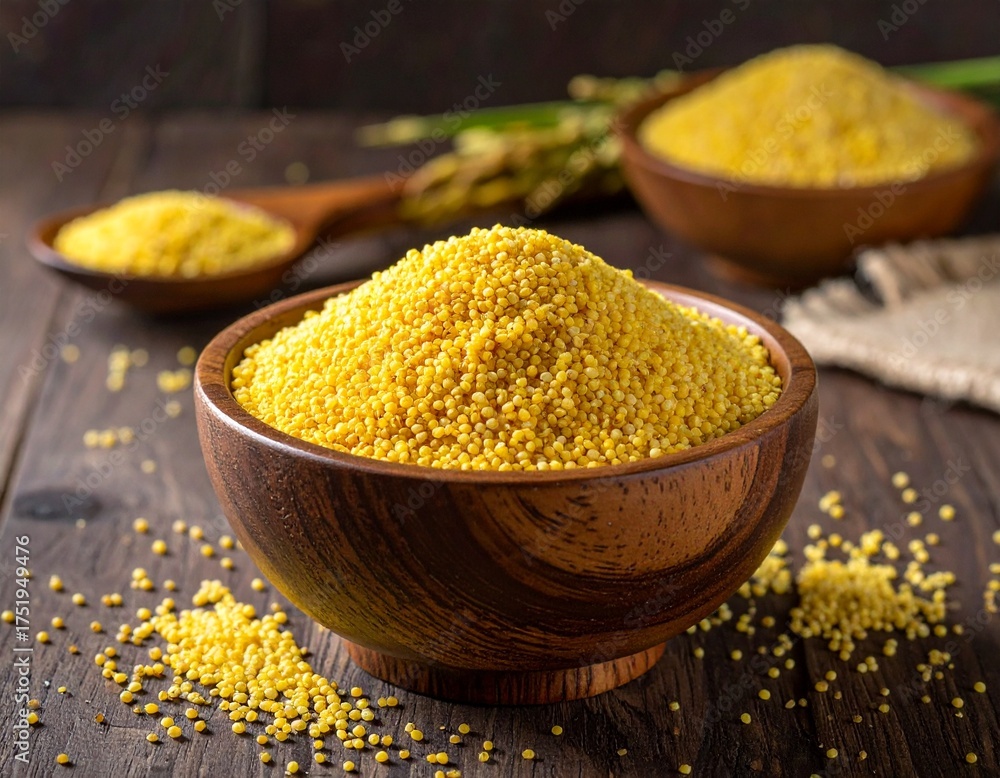
- The grain is used as food after husking. It is eaten in the form of cakes or porridge, and forms food for invalids when boiled with milk.
- Used as food for cage-birds, and for feeding poultry.
- The straw is thin and leafy and is used as fodder for cattle.
- Medicinal uses- The grain is astringent, diuretic and laxative, and is useful externally in rheumatism. But it possesses heating properties, and when taken alone, sometimes causes diarrhoea. It is popular remedy for alleviating the labour pain during childbirth. The plant is considered to be sweet, acrid and aphrodisiac.
Diseases
Fungal diseases-
- Smut, caused by Ustilago crameri
- Downy mildew or green ear, caused by Sclerospora graminicola
- Blast, caused by Piriculalia setariae
- Leaf spot or blotch, caused by Cochlobolus setariae
Bacterial diseases-
- Blight or spot, caused by Pseudomonas albopercipitans
- Brown stripe, caused by Pseudomonas setariae
Comments
Post a Comment